$2,500.00 Original price was: $2,500.00.$2,300.00Current price is: $2,300.00.
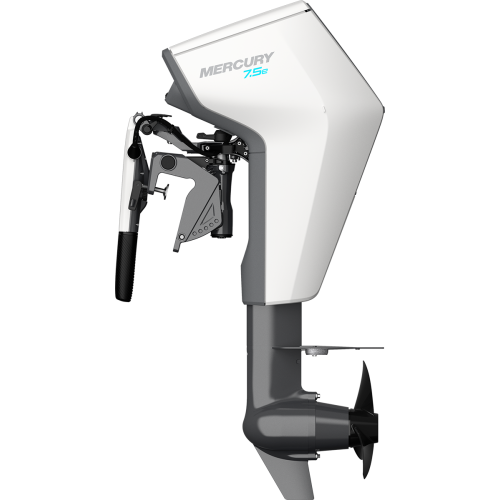
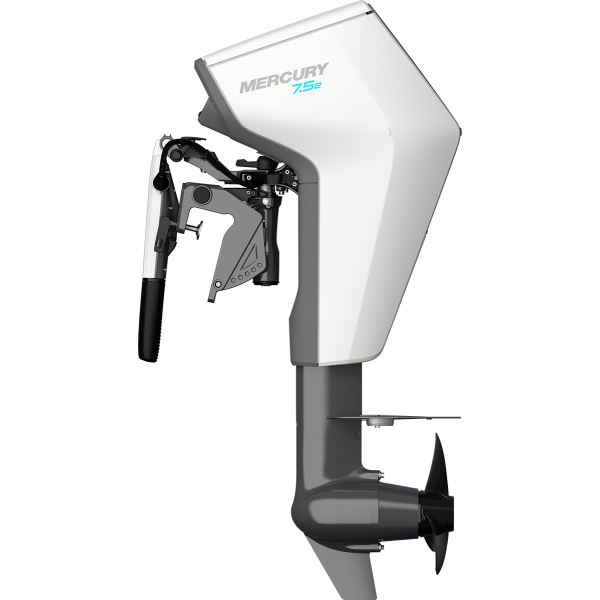
The Mercury Avator 7.5e is a compact electric outboard designed for small boats, tenders and secondary propulsion on sailboats. Mercury describes the 7.5e as delivering speed and acceleration performance similar to a 3.5 hp internal-combustion outboard, while using a quiet electric drive and an integrated 1 kWh lithium-ion battery. It is available with tiller or remote steering and uses a quick-connect battery system for straightforward setup and removal.
The Avator 7.5e uses a transverse flux motor designed to provide high torque from a compact electric propulsion system. Mercury rates the motor at 750 W of prop shaft power with 916 W of input power and a rated voltage of 48 V. Mercury compares its acceleration and speed performance with a 3.5 hp combustion outboard, making the 7.5e a practical option where compact electric propulsion is preferred.
Electric propulsion also eliminates exhaust emissions at the point of use. Mercury highlights the Avator’s quiet operation and reduced vibration as advantages for boating where low noise is important.
The Avator 7.5e uses an integrated 1 kWh lithium-ion battery. The battery slides into the motor beneath the flip-up top cowl, eliminating the need for external battery cables between the motor and battery. Mercury describes the battery as a quick-connect design that can be removed and replaced when needed.
The battery is rated IP67. Mercury’s published Avator specifications list the battery weight at approximately 7.6 kg (17 lb). The battery can be removed from the motor for charging or storage, which can make handling and transportation easier.
Mercury’s published performance test used a 13-foot Veer V13 boat with a 382-pound dry weight. With one fully charged 1 kWh battery, Mercury reports approximately 60 minutes or 5 miles at constant full throttle and up to 19 hours or 34 miles at constant 25% throttle. These are test results rather than guaranteed results for every boat.
Actual range and runtime depend on boat design, total load, weather, water conditions, speed, throttle setting and battery condition. Use Mercury’s published figures as a reference point when estimating the expected operating range of a particular installation.
The Avator 7.5e is designed for quiet electric propulsion. Mercury states that the 7.5e is four times quieter to the operator than a 3.5 hp four-stroke outboard at full throttle and reports reduced tiller-handle vibration compared with a comparable combustion outboard.
This low-noise operation can be useful for tender boats, fishing, wildlife observation and recreational boating where minimizing engine noise is desirable.
The 7.5e battery fits beneath the flip-up cowl and connects without conventional external battery cables. The quick-connect design allows the battery to be removed from the outboard and replaced with another compatible battery when additional operating time is required.
Battery handling should follow Mercury’s instructions, including the specified charging, storage and temperature requirements. Do not substitute an incompatible battery or charger.
The standard charger supplied for the Avator 7.5e is rated at 110 W. Mercury states that the standard charger can be used from a household electrical outlet. Faster compatible charging options are also available, depending on the market and configuration.
Charging time depends on battery state of charge, charger output and operating conditions. The battery should be charged using a Mercury-approved compatible charger and according to the manufacturer’s instructions.
The Avator 7.5e is available in both tiller and remote-steer configurations. The multi-purpose tiller can be adjusted for different operating positions and folds down to help with carrying and storage.
Remote-control versions are intended for boats where the operator controls the outboard from a console. Mercury offers digital control options for different centre- and side-console arrangements.
The standard Avator 7.5e propeller is a three-blade composite design measuring approximately 12.7 inches with a 7-inch pitch. Mercury also identifies additional propeller pitch options for the 7.5e, including 9-inch and 11-inch pitches.
Propeller selection affects acceleration, load handling and operating efficiency. Mercury’s installation documentation should be followed when selecting or replacing the propeller; the manufacturer specifically warns against using unsuitable aftermarket propellers.
The Avator 7.5e is offered with 15-inch, 20-inch and 25-inch shaft lengths, corresponding to approximately 381 mm, 508 mm and 635 mm. The correct shaft length depends on the boat’s transom and the required propeller position in the water.
Choosing the correct shaft length is important for efficient propulsion and proper installation. Measure the transom before ordering rather than assuming that the shortest or longest shaft will fit.
| Specification | Mercury Avator 7.5e |
|---|---|
| Input power | 916 W |
| Rated prop shaft power | 750 W |
| Rated voltage | 48 V |
| Battery | Integrated 1 kWh lithium-ion |
| Battery weight | Approximately 7.6 kg / 17 lb |
| Battery IP rating | IP67 |
| Weight excluding battery and transom bracket | Approximately 16.7 kg / 37 lb |
| Weight excluding battery | Approximately 19.5 kg / 43 lb |
| Standard charger | 110 W |
| Steering | Tiller or remote |
| Standard propeller | 12.7 in x 7 pitch |
| Shaft lengths | 15 in / 381 mm; 20 in / 508 mm; 25 in / 635 mm |
Mercury positions the Avator 7.5e for a variety of small boats, tenders and sailboats used with the outboard as secondary propulsion. Its compact electric format can be particularly useful where quiet operation, simple battery handling and the absence of fuel storage are priorities.
Before selecting the motor, confirm the boat manufacturer’s recommended outboard power, transom requirements, shaft length and maximum operating load. The published Mercury performance figures were obtained under specific test conditions and should not be treated as universal performance specifications.
Mercury states that Avator outboards use corrosion-preventive materials and coatings for operation in freshwater or saltwater environments. When operating in saltwater, follow Mercury’s cleaning, inspection and corrosion-protection procedures to maintain the motor and its components.
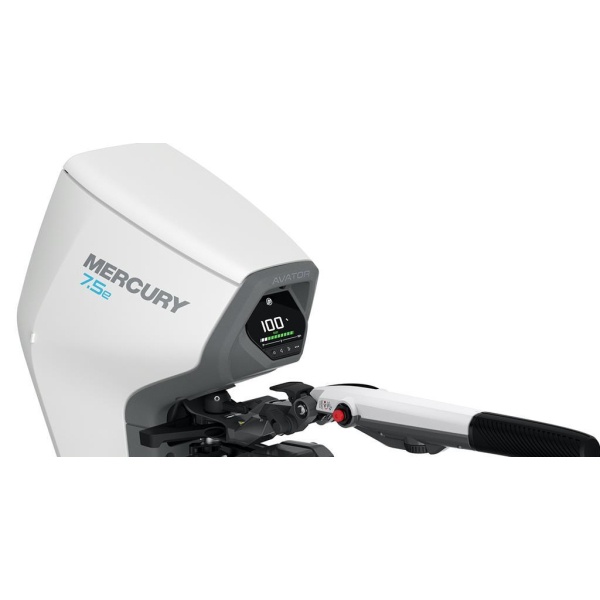
The Avator system provides information designed to help the operator monitor battery condition and remaining range. Mercury also offers a SmartCraft Connect module as an accessory for the 7.5e, which can add connectivity to the Mercury Marine app and features such as GPS-based range visualization, digital gauges and alerts.
Connectivity features depend on the equipment installed and the applicable Mercury system configuration. They should not be confused with the basic motor’s standard operating functions.
If you are comparing the Avator 7.5e with other electric outboard motors, compare rated power, battery capacity, shaft length, steering configuration, weight, charging requirements and expected range. The best specification match depends on the boat and the way you intend to use it.
For product availability, compatibility questions or installation information, contact the Performance Engines team before ordering.
The Avator 7.5e has 750 W of rated prop shaft power and 916 W of input power. Mercury describes its speed and acceleration performance as similar to a 3.5 hp internal-combustion outboard.
The 7.5e uses an integrated 1 kWh lithium-ion battery. The battery is designed to quick-connect beneath the motor’s flip-up cowl and is rated IP67.
In Mercury’s test using a 13-foot Veer V13 boat, one fully charged 1 kWh battery provided approximately 60 minutes or 5 miles at constant full throttle, and up to 19 hours or 34 miles at constant 25% throttle. Actual results vary with boat, load and conditions.
The Avator 7.5e is available with 15-inch, 20-inch and 25-inch shafts, or approximately 381 mm, 508 mm and 635 mm.
Yes. Mercury lists both tiller and remote-steer configurations for the Avator 7.5e. Remote control options are designed for centre- and side-console boat layouts.
The published Mercury specifications list a 110 W standard charger for the Avator 7.5e. Mercury also offers compatible higher-speed charging options, depending on configuration and market.