$3,500.00 Original price was: $3,500.00.$2,900.00Current price is: $2,900.00.
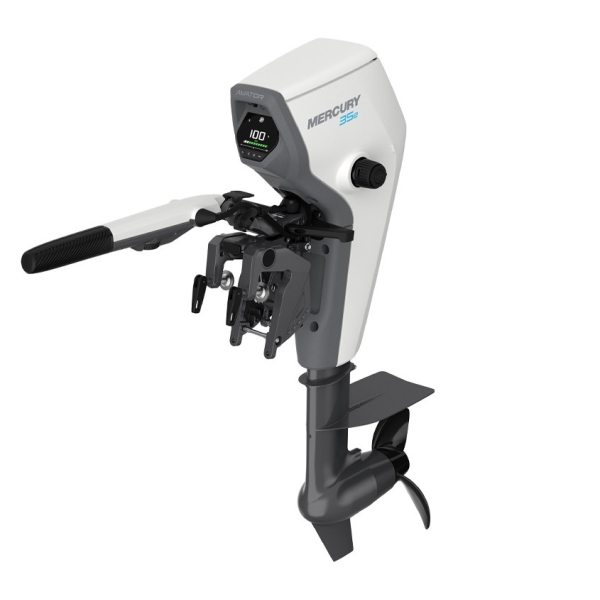
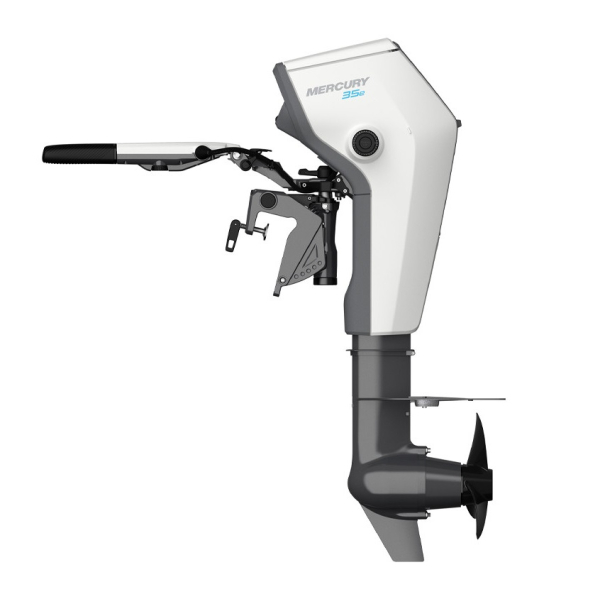
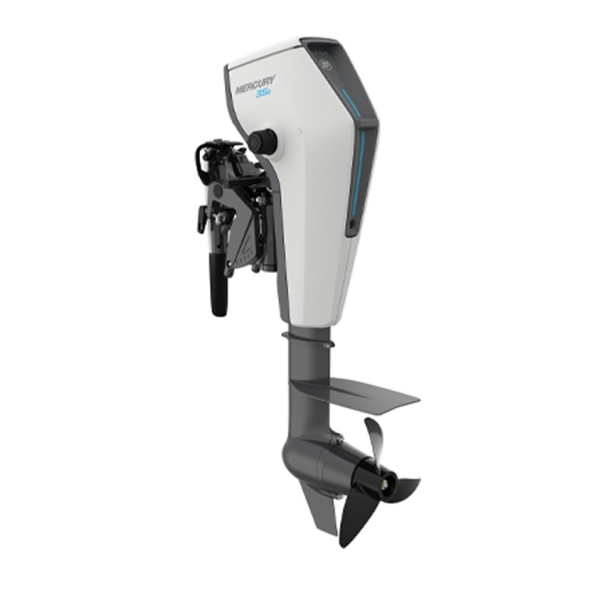
The Mercury Avator 35e is a modular electric outboard designed for boats that need more propulsion than compact portable electric motors can provide. Mercury rates the 35e at 4,467 W of input power and 3,700 W of rated prop-shaft power on a 48 V electrical system. Mercury’s internal performance testing describes acceleration similar to a 9.9 hp four-stroke outboard.
The 35e uses remote 2,300 Wh or 5,400 Wh Avator batteries and requires an Avator Power Center with at least two batteries. Up to four compatible batteries can be connected through the Power Center, allowing the propulsion system to be sized for the intended runtime and boat application.
The Avator 35e delivers 4,467 W of input power and 3,700 W of rated prop-shaft power. Its transverse flux electric motor is designed to provide smooth torque and efficient propulsion. Mercury compares the 35e’s acceleration with a 9.9 hp four-stroke outboard under its stated test conditions.
The 35e is therefore positioned between Mercury’s compact 7.5e and higher-output 75e/110e models. It is intended for boaters who need a modular electric propulsion system while retaining the portability and control options of an outboard installation.
The Avator 35e uses remote battery modules rather than an integrated battery. Mercury lists compatibility with 2,300 Wh and 5,400 Wh Avator batteries. The 35e requires an Avator Power Center and at least two batteries.
The Power Center acts as the system hub, distributing power from the connected battery bank to the outboard and allowing the connected batteries to be charged through the system. Mercury states that up to four compatible batteries can be connected to extend range and runtime.
Battery capacity should be selected around the boat’s expected cruising speed, load and trip duration. A higher battery capacity does not automatically produce a fixed range because range changes with hull design, displacement, throttle setting, water conditions, propeller and battery state of charge.
Mercury’s published example for the Avator 35e shows a 12-foot Lund WC-12 test boat with two fully charged 2,300 Wh batteries. At 50% throttle, Mercury reports approximately 2 hours 30 minutes of runtime and 13.3 miles of distance. Mercury states that actual results vary with boat, load, environmental conditions and battery state of charge.
The Avator Power Center is required for the 35e and connects the outboard to the battery bank. Mercury describes it as an integrated hub that distributes power throughout the electric propulsion system and can charge up to four connected batteries from a single charging port.
Because the 35e requires at least two batteries, buyers should plan the motor, Power Center, battery modules, charger, controls and cabling as one complete propulsion system rather than selecting the motor by itself.
Mercury lists 230 W, 520 W and 1 kW charger options within the Avator battery and charging ecosystem. The 1 kW charger is associated with the 5,400 Wh battery configuration.
Mercury states that a portable 520 W Avator charger can recharge two depleted 5,400 Wh batteries in approximately 20 hours, while a vessel-integrated 1 kW charger can reduce charging time by more than 50%. Actual charging time depends on battery capacity, charger configuration and state of charge.
The Avator 35e is available with tiller or remote steering. The multi-purpose tiller can be adjusted for operator comfort, while digital remote controls are available for console boats in different centre- and side-console mounting arrangements.
Select the steering configuration according to the boat layout and intended installation. Console installations should be planned with the compatible Mercury controls, displays and wiring.
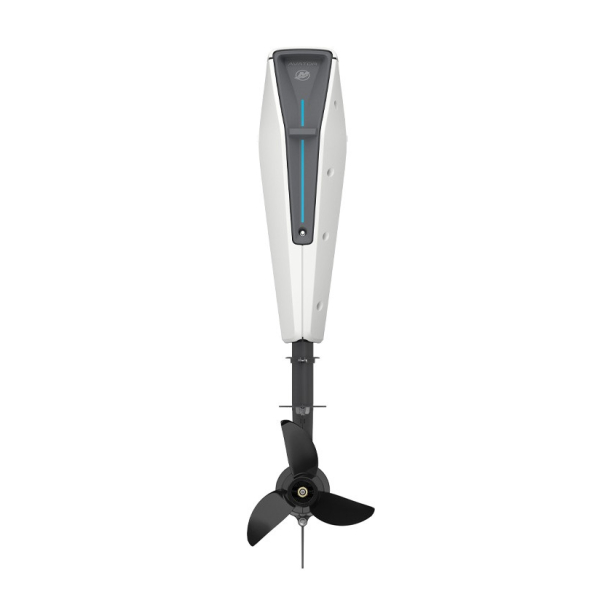
The standard Avator 35e propeller is a 12.7-inch diameter propeller with 7 inches of pitch. Mercury’s Avator specification tables list this as the standard propeller for the 35e.
Propeller selection affects acceleration, cruising efficiency, load carrying and maximum speed. Use Mercury’s compatible propeller specifications when changing the propeller rather than selecting a generic propeller solely by diameter and pitch.
The Avator 35e is offered with 15-inch, 20-inch and 25-inch shaft lengths, corresponding to 381 mm, 508 mm and 635 mm. The correct shaft length places the propeller at the appropriate depth and helps maintain efficient propulsion.
| Configuration | Length |
|---|---|
| Short | 15 in / 381 mm |
| Long | 20 in / 508 mm |
| Extra-long | 25 in / 635 mm |
Mercury’s Avator specification table lists the 35e at approximately 18.6 kg (41 lb) excluding the battery and transom bracket, or approximately 21.3 kg (47 lb) excluding the battery. The compatible 2,300 Wh battery is listed at approximately 21.7 kg (48 lb).
These figures should be considered when planning transport, battery placement and transom loading. The final system weight depends on the number and capacity of batteries installed.
Mercury’s Avator platform provides connected-system features through its SmartCraft ecosystem. Mercury states that users can use the app to access performance data, view range estimates, connect with their dealer and wirelessly update the Avator system.
Available connected features depend on the installed system and compatible equipment. Verify the required display, communication and control components for the specific 35e configuration.
The Avator 35e is designed for smooth and quiet electric propulsion. Mercury reports that its internal testing found the Avator 35e 63% quieter than a 6 hp four-stroke combustion outboard at full throttle and with 60% less transmitted tiller-handle vibration in the stated test comparison.
These are Mercury’s internal test comparisons rather than universal results. Actual sound and vibration levels vary with the boat, mounting arrangement, operating conditions and surrounding environment.
Mercury describes Avator outboards as suitable for freshwater and saltwater operation and uses corrosion-preventive materials and coatings throughout the system. Regular rinsing and inspection remain important after saltwater use, particularly around the propeller, lower unit, mounting hardware and electrical connections.
| Specification | Avator 35e |
|---|---|
| Input power | 4,467 W |
| Rated prop-shaft power | 3,700 W |
| Rated voltage | 48 V |
| Compatible batteries | 2,300 Wh or 5,400 Wh remote batteries |
| Battery chemistry | Lithium nickel manganese cobalt |
| Battery IP rating | IP67 |
| Minimum battery configuration | Two batteries with Power Center |
| Maximum battery configuration | Up to four compatible batteries |
| Steering | Tiller or remote |
| Standard propeller | 12.7 in × 7 pitch |
| Shaft lengths | 15 in / 381 mm; 20 in / 508 mm; 25 in / 635 mm |
| Motor weight excluding battery | Approximately 21.3 kg / 47 lb |
| 2,300 Wh battery weight | Approximately 21.7 kg / 48 lb |
| Compatible chargers | 230 W; 520 W; 1 kW for 5,400 Wh battery |
Mercury positions the Avator 35e for recreational boating applications where modular electric propulsion can provide quiet operation and flexible battery capacity. Mercury’s published performance material uses examples including a 12-foot Lund WC-12 boat and an 18-foot pontoon with three 2,300 Wh batteries.
Before installation, confirm the boat manufacturer’s maximum outboard rating, transom requirements, shaft length and system weight. The 35e’s actual performance depends on the complete boat, battery configuration, propeller and operating conditions.
An Avator 35e installation should be planned as a complete system comprising the outboard, Power Center, minimum two compatible batteries, charger, steering controls and required electrical connections. Battery placement should account for weight distribution, service access and cable routing.
Use Mercury’s current installation documentation for electrical protection, battery connections, charging and control-system requirements. Do not substitute incompatible batteries or charging components.
If you are comparing the Avator 35e with other electric outboard motors, compare prop-shaft power, battery capacity, system voltage, Power Center requirements, shaft length, steering configuration, charging time and total system weight.
For availability, compatibility or installation questions, contact the Performance Engines team before ordering.
The Avator 35e has 4,467 W of input power and 3,700 W of rated prop-shaft power on a 48 V system. Mercury’s internal testing describes acceleration similar to a 9.9 hp four-stroke outboard.
The 35e requires an Avator Power Center and at least two compatible batteries. Mercury states that the Power Center can connect up to four batteries.
Mercury lists remote 2,300 Wh and 5,400 Wh batteries as compatible with the 35e. The 5,400 Wh battery is part of the higher-capacity Avator battery range.
The Avator 35e is available with 15-inch, 20-inch and 25-inch shafts, equivalent to 381 mm, 508 mm and 635 mm.
Yes. Mercury lists both tiller and remote steering configurations for the Avator 35e. Digital remote controls are available for compatible console installations.
The standard Avator 35e propeller is 12.7 inches in diameter with 7 inches of pitch.