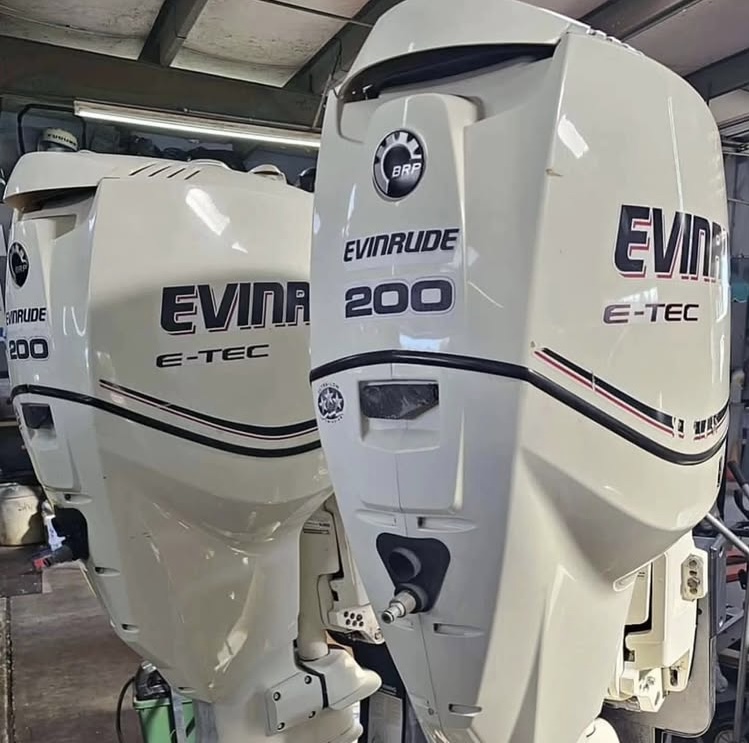
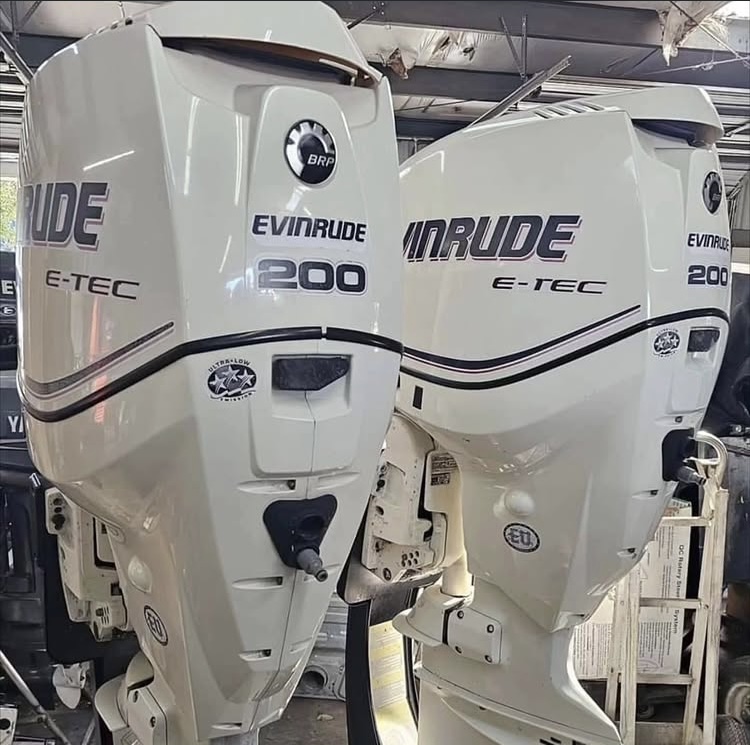
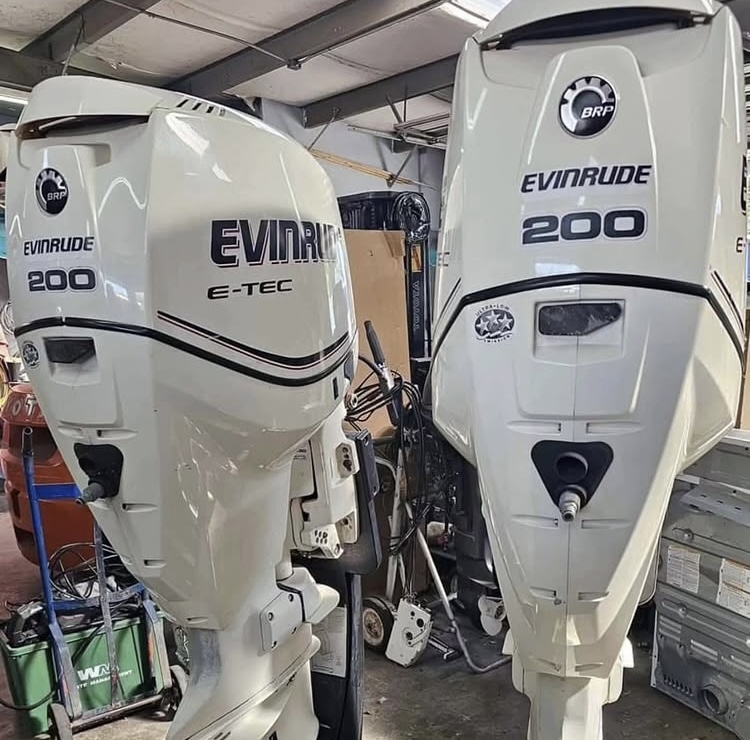
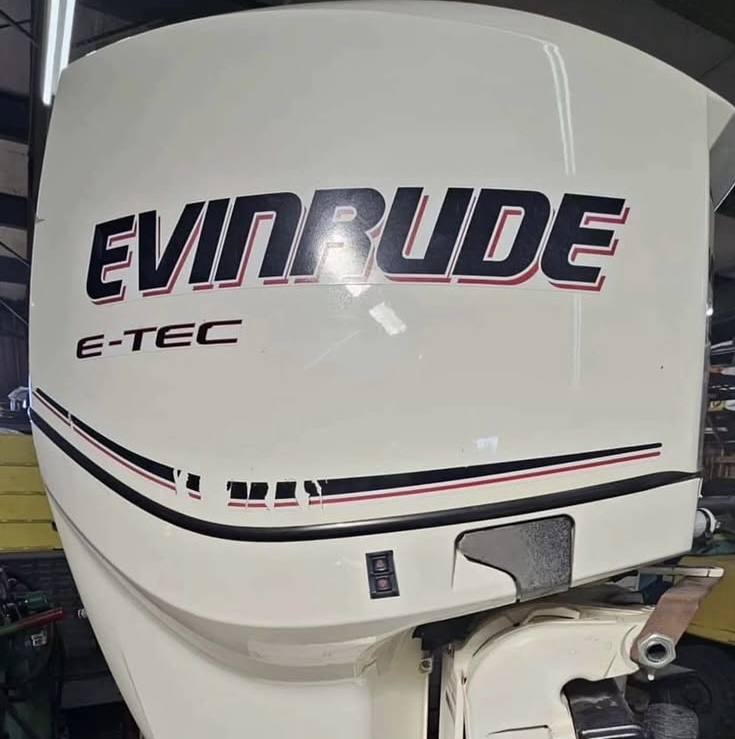
$7,000.00 Original price was: $7,000.00.$6,500.00Current price is: $6,500.00.
This Twin 2011 Evinrude E-TEC 200HP Outboard package is built around two Evinrude E-TEC 200 horsepower direct-injection two-stroke outboards from the 2011 model generation. The standard 2011 150–200 HP E-TEC family used a 60-degree V6 powerhead, while Evinrude also offered a separate 200 H.O. 90-degree V6 platform. Because the product title specifies 200 HP rather than 200 H.O., this page treats the package as the standard 2011 200 HP E-TEC configuration and avoids mixing it with the 200 H.O. specifications.
For a twin-engine boat, two 200 HP engines provide a combined 400 horsepower. Exact weight, shaft length, steering equipment and gearcase configuration depend on the individual engine model codes, so buyers should confirm the identification plates and serial numbers before ordering rigging or replacement parts.
The 2011 Evinrude product and service documentation identifies the 150–200 HP E-TEC models as a 60-degree V6 family. The documented engine group uses a 2.6-liter-class powerhead, with the 200 HP version rated at 200 HP at approximately 5,500 RPM and a full-throttle operating range of 5,000–6,000 RPM.
This is important because Evinrude’s 200 HP range also included a 200 H.O. 90-degree V6 model using a larger 3.3-liter powerhead. That H.O. engine is a different platform and should not be used as the specification basis for this standard 2011 200 HP listing.
| Specification | Per Engine |
|---|---|
| Manufacturer | Evinrude |
| Model year | 2011 |
| Rated output | 200 HP / approximately 147 kW |
| Engine type | Two-stroke V6 E-TEC direct injection |
| V-angle | 60 degrees |
| Displacement | Approximately 2,589 cc / 2.6 L |
| Full-throttle range | 5,000–6,000 RPM |
| Rated power speed | Approximately 5,500 RPM |
| Fuel system | E-TEC direct injection |
| Lubrication | Electronic multi-point oiling |
| Starting | Electric |
| Trim | Power trim and tilt |
| Steering | Remote steering |
| Gear ratio | Approximately 1.86:1 on documented 60-degree V6 configuration |
2011 Evinrude service documentation distinguishes the standard 150–200 HP 60-degree V6 family from the 200–300 HP 90-degree V6 family. The 60-degree V6 documentation identifies the standard 200 HP engine with a 2.6-liter-class displacement and 5,000–6,000 RPM full-throttle range.
With two 200 HP engines installed, this package provides a nominal 400 HP total. A twin installation can provide additional control, redundancy and maneuverability compared with a single outboard, but the boat must be designed and rated for the combined power and engine weight.
Engine spacing, steering geometry, propeller selection, mounting height and control synchronization all need to be matched to the hull. The two engines should be treated as a complete propulsion system rather than simply two independent 200 HP motors.
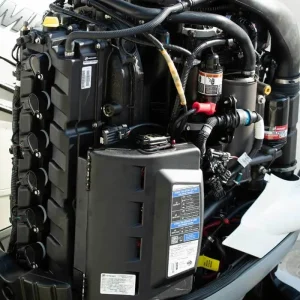
Evinrude E-TEC technology uses direct fuel injection and electronic engine management. The engine management module controls fuel delivery, ignition and other operating parameters according to engine conditions.
The direct-injection design is one of the defining characteristics of E-TEC engines. It differs from the conventional carbureted and older electronic fuel-injection systems used by many earlier two-stroke outboards.
The standard 2011 E-TEC 200 HP uses electronically managed direct injection and a dedicated two-stroke lubrication system. Evinrude’s 2011 operator documentation specifies Evinrude XD-series two-stroke lubricant or an appropriate oil meeting the specified marine two-stroke requirements.
For a used twin package, inspect both engines independently. Fuel contamination, restricted fuel supply, injector problems or lubrication-system faults on one engine can cause different operating symptoms from the other engine even when the engines were purchased as a pair.
The E-TEC platform includes an engine-controlled charging system designed to support the boat’s electrical requirements. On a twin installation, the charging contribution from both engines can be useful for electronics, starting batteries and onboard equipment, but the vessel’s battery-bank and charging architecture should be designed specifically for the installation.
Inspect battery cables, grounds, charging connections and engine harnesses carefully on a used 2011 package. Corrosion at electrical connections is particularly important on engines that have spent significant time in saltwater.
Propeller selection should be based on the exact engine model, gearcase, shaft length and boat. The documented standard 60-degree V6 200 HP configuration uses an approximately 1.86:1 gear ratio, so propeller selection should account for that gear reduction and the engine’s 5,000–6,000 RPM operating range.
For twin installations, the propellers should be selected as a matched set for the specific hull. If one engine reaches a different RPM from the other under the same load, investigate propeller condition, pitch, engine height, throttle synchronization and engine performance rather than assuming the difference is normal.
The 2011 E-TEC 200 HP platform was designed for remote-control applications. A twin installation requires compatible throttle and shift controls, steering equipment, engine harnesses and instrumentation.
Confirm the exact control-generation requirements before purchasing replacement rigging. Components from later E-TEC G2 engines should not automatically be assumed to be compatible with a 2011 first-generation E-TEC.
Installing two 200 HP outboards requires careful planning around transom strength, engine spacing and steering. Verify the boat manufacturer’s maximum horsepower and maximum allowable transom weight before installation.
Twin 200 HP outboards are commonly associated with larger center consoles, offshore fishing boats and other vessels where high propulsion output and maneuverability are required. A twin setup can also provide operational redundancy because the boat has two propulsion units.
Saltwater use requires additional attention to corrosion. Inspect the engine brackets, sacrificial anodes, lower units, steering hardware, electrical connectors and cooling-water passages. Regular freshwater flushing and appropriate corrosion protection should be part of the maintenance routine.
Maintenance should follow the service documentation for the exact 2011 model codes. Important areas include spark plugs, fuel filters, injectors, oil supply, water-pump components, thermostats, gearcase lubricant, propellers, battery connections and steering components.
On a twin package, maintain a service record for each engine separately. Engine hours, diagnostic history, compression results and component replacement should be documented individually because the two motors may have experienced different operating conditions.
Before buying this package, obtain the model and serial number from both engines. Confirm that both motors are actually 2011 standard 200 HP E-TEC models and determine whether their shaft lengths, gearcases and rigging components match.
A professional inspection should ideally include compression testing, diagnostic scanning, charging-system testing, cooling-system checks, lower-unit inspection, propeller inspection and a review of stored engine faults.
Also inspect the boat-side installation. A healthy pair of engines can still require substantial work if the existing steering, controls, electrical system or transom is not compatible with the twin 200 HP configuration.
| Feature | 2011 Standard 200 HP | 200 H.O. |
|---|---|---|
| V configuration | 60° V6 | 90° V6 |
| Displacement | Approx. 2.6 L | Approx. 3.3 L |
| Engine family | 150–200 HP E-TEC | 200–250 HP H.O. family |
| Full-throttle range | 5,000–6,000 RPM | 4,500–5,800 RPM on documented generation |
| Gear ratio | Approx. 1.86:1 | Approx. 1.85:1 |
This distinction prevents a common specification error: the 3.3-liter 90-degree V6 200 H.O. should not be described as the same engine as the standard 2011 200 HP 60-degree V6. Evinrude’s technical documentation lists these as separate engine families.
Each engine is rated at 200 HP, giving the twin package a nominal 400 HP combined.
Yes. The E-TEC 200 HP is a two-stroke direct-injection V6 outboard.
The standard 150–200 HP 60-degree V6 E-TEC family uses a powerhead in the 2.6-liter class, approximately 2,589 cc.
The documented full-throttle operating range for the standard 150–200 HP 60-degree V6 family is 5,000–6,000 RPM.
No. The standard 200 HP uses the 60-degree V6 platform, while the 200 H.O. belongs to the larger 90-degree V6 family. They should not be treated as interchangeable specifications.
Check both model and serial numbers, compression, diagnostic history, fuel and oil systems, cooling-water flow, lower units, propellers, charging systems, steering and the condition of the boat’s twin-engine rigging.
Not automatically. Transom construction, engine spacing, shaft length, steering system, total engine weight, mounting arrangement and the manufacturer’s specific installation requirements must all be verified.
Yes. A twin installation should normally use a properly matched propeller setup appropriate for the hull, gear ratio, load and intended operating RPM. The exact propeller specification should be determined from the boat and engine configuration.
The Twin 2011 Evinrude E-TEC 200HP Outboard package combines two standard 200 HP E-TEC V6 engines for a nominal 400 HP total. The 2011 platform uses direct fuel injection, electronic engine management and two-stroke E-TEC technology, making it a distinctive option for large twin-outboard applications.
Before purchasing or installing the package, verify the model codes and serial numbers of both engines and confirm the complete rigging, steering, shaft-length and transom requirements. You can also browse our outboard engines category to compare other marine propulsion options.