
$1,200.00 Original price was: $1,200.00.$1,050.00Current price is: $1,050.00.
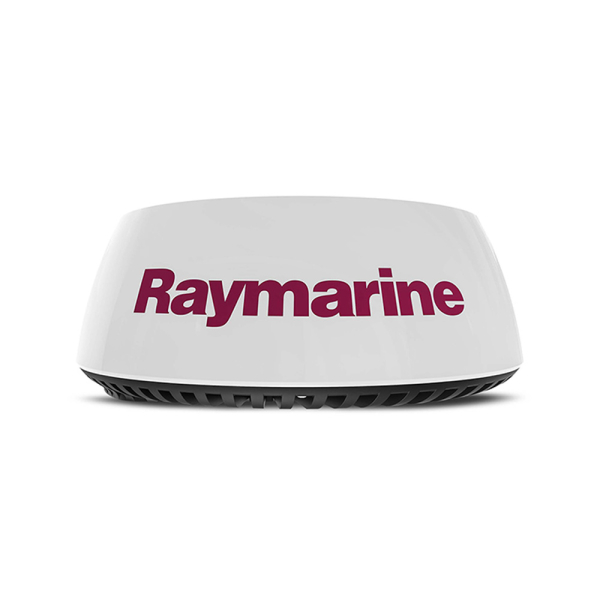
The Raymarine QUANTUM Q24C 18-inch radar is a compact solid-state marine radar designed for navigation, target detection and situational awareness on the water. This product listing identifies an X-band solid-state transmitter with pulse compression technology, a patch-array antenna, 20 W peak power output and tracking for up to 10 simultaneous radar targets. Its compact 541 mm diameter housing and 5.6 kg weight make it a practical radar option where installation space matters.
The Q24C uses an X-band solid-state transmitter with pulse compression technology. The product specifications list a transmit frequency range of 9354 MHz to 9446 MHz and a peak power output of 20 W.
Solid-state radar architecture provides a compact solution for marine navigation equipment. The Q24C is designed to provide radar information across a wide selection of range scales, allowing the operator to select a view appropriate to the current navigation situation.
The listed range scales extend from 1/16 nautical mile through 24 nautical miles. Available settings include 1/16, 1/8, 1/4, 3/8, 1/2, 3/4, 1, 1.5, 2, 3, 4, 6, 8, 12, 16 and 24 nautical miles.
The appropriate range depends on the operating environment, visibility, sea conditions and the targets being monitored. Radar range should therefore be selected according to the immediate navigation requirements rather than treating the maximum range as a guaranteed detection distance for every target.
The Raymarine Q24C product information specifies tracking of up to 10 simultaneous radar targets. Target tracking can help an operator maintain awareness of multiple contacts while navigating in areas where surrounding vessel traffic or other radar returns need to be monitored.
Actual target detection and tracking performance can vary with target size, distance, environmental conditions, installation and other operating factors.
The transmitter supports CHIRP lengths from 400 ns to 22 µs and pulse widths from 40 ns to 14.7 µs. The listed CHIRP bandwidth is up to 32 MHz, with a pulse repetition frequency range of 920 Hz to 5900 Hz.
These specifications describe the radar’s transmission architecture and should be considered alongside the installation, display and operating environment when evaluating a marine radar system.
The Q24C uses a patch-array antenna with nominal beamwidth of 4.9 degrees horizontally and 20 degrees vertically. The antenna uses horizontal polarization and rotates at a nominal 24 rpm.
The compact antenna design contributes to the radar’s relatively small physical footprint, with a listed diameter of 541.0 mm.
The radar accepts either 12 V DC or 24 V DC nominal supply voltage. Its specified operating voltage range is 10.8 V DC to 31.2 V DC.
Maximum transmit-mode power consumption is listed as 17 W, while standby consumption is 7 W. For radars connected through Wi-Fi, sleep-mode consumption is listed as 2 W.
In standby mode, the listed configuration has the scanner rotation switched off and scanner transmission switched off, while the Wi-Fi link remains on. This allows the radar system to remain connected without continuously transmitting.
For installation and operating procedures, follow the manufacturer’s requirements for the connected display, power supply, networking and radar configuration.
The Q24C has an IPX6 waterproof rating according to the supplied product specifications. The operating temperature range is -10°C to 55°C, while the storage temperature range is -25°C to 70°C.
The listing specifies operation in humidity up to 95% at 35°C and a maximum wind-speed specification of 100 knots. For storage, the source specifically states that the unit should be stored upright and that the vents on the underside should not be blocked.
| Specification | Raymarine QUANTUM Q24C |
|---|---|
| Radar type | X-band solid-state with pulse compression |
| Peak power output | 20 W |
| Antenna type | Patch array |
| Nominal rotation speed | 24 rpm |
| Horizontal beamwidth | 4.9° nominal |
| Vertical beamwidth | 20° nominal |
| Diameter | 541.0 mm (21.3 in) |
| Height | 209.5 mm |
| Weight | 5.6 kg (12.35 lb) |
| Nominal supply voltage | 12 V DC or 24 V DC |
| Operating voltage | 10.8–31.2 V DC |
| Transmit power consumption | 17 W maximum |
| Standby power consumption | 7 W |
| Wi-Fi sleep power | 2 W |
| Waterproof rating | IPX6 |
| Maximum wind speed | 100 knots |
| Target tracking | Up to 10 simultaneous radar targets |
Before installing the Q24C, confirm that the planned mounting location provides the required clearance and a suitable radar field of view. The source specifications identify a 541.0 mm diameter and 209.5 mm height, so the physical dimensions should be checked against the available mounting area.
Power wiring should be planned around the radar’s 10.8–31.2 V DC operating range. The radar installation should also account for the connected marine display and any networking or Wi-Fi requirements of the vessel’s electronics system.
The Q24C can be considered for marine navigation installations where a compact solid-state radar is required for monitoring radar targets and maintaining situational awareness. Its available range scales, target-tracking capability and compact patch-array design make it suitable for vessels where radar information needs to be integrated into the helm without using a large open-array antenna.
Radar performance depends on installation quality, antenna position, vessel motion, weather, sea conditions, target characteristics and the connected display system.
If you are comparing the Q24C with other marine radar systems, consider antenna type, physical dimensions, power requirements, target-tracking functions, networking requirements and the range scales required for your vessel.
For questions about availability, compatibility or installation requirements, contact the Performance Engines team before ordering.
The Q24C uses an X-band solid-state transmitter with pulse compression technology and a patch-array antenna.
The supplied specifications list range scales from 1/16 nautical mile up to 24 nautical miles. The available range scale is not the same as a guaranteed detection distance, because radar performance depends on the target and operating conditions.
The product specifications state that the Q24C can track up to 10 simultaneous radar targets.
The radar accepts either 12 V DC or 24 V DC nominal supply voltage, with a specified operating range of 10.8 V DC to 31.2 V DC.
The listed maximum power consumption in transmit mode is 17 W. Standby consumption is 7 W, and Wi-Fi-connected radar sleep mode is listed at 2 W.
The supplied specifications list a diameter of 541.0 mm and a height of 209.5 mm. The listed weight is 5.6 kg, or approximately 12.35 lb.

Reviews
There are no reviews yet.