$5,000.00 Original price was: $5,000.00.$4,500.00Current price is: $4,500.00.
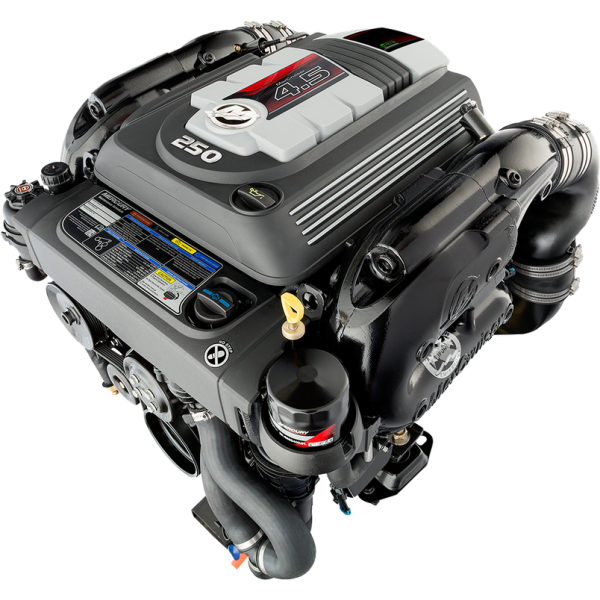
The Mercury 250 HP ECT 4.5L Inboard Engine is a 4.5-liter V6 gasoline marine engine designed for boats that need 250 horsepower in a compact inboard power package. Performance Engines lists this product as a new Mercury 250 HP ECT 4.5L inboard engine, making it relevant for suitable marine repower projects and recreational inboard applications.
Mercury’s 4.5L platform combines multi-point electronic fuel injection, electronic engine management and marine-specific cooling and corrosion-protection options. Mercury publishes the 250 HP version at 186 kW with a full-throttle operating range of 4,800–5,200 rpm.
The Mercury 4.5L 250 is rated at 250 HP / 186 kW. Mercury’s published technical specifications give the 250 HP model a full-throttle operating range of 4,800–5,200 rpm.
Actual boat speed, acceleration and fuel consumption depend on hull design, vessel weight, propeller, drive or transmission ratio, loading and operating conditions. The correct engine should therefore be selected as part of the complete propulsion system rather than by horsepower alone.
The 4.5L Mercury platform uses a V6 configuration with approximately 275 cubic inches / 4.5 liters of displacement. The 250 HP model is designed around the same 4.5L marine architecture used across Mercury’s 200–250 HP range.
The V6 layout provides a compact multi-cylinder package for applications where installation space matters. When replacing an existing engine, confirm mounting dimensions, exhaust routing, service access and drivetrain compatibility before ordering.
Mercury’s 4.5L uses multi-point electronic fuel injection to manage the air-to-fuel mixture. Mercury describes the MPI system as continuously fine-tuning the air-to-fuel ratio to support the combination of power and efficiency expected from the engine.
Because the system is electronically controlled, the installation should include the correct Mercury engine-control components, wiring and fuel-system arrangement for the exact engine configuration.
The Mercury 4.5L platform incorporates electronic engine control and Engine Guardian. Mercury describes Engine Guardian as a monitoring system that can adjust engine functions when necessary to help protect the engine and assist the operator.
Mercury also supports SmartCraft digital technologies across its modern engine range. The exact gauges, displays, controls and networking equipment supplied with a particular 4.5L configuration should be confirmed before purchase.
Mercury identifies Adaptive Speed Control as a feature of the 4.5L platform. It is designed to maintain engine rpm as load or operating conditions change, which can help provide more consistent control when the boat encounters changing conditions.
Mercury’s current 4.5L information describes an alternator capable of delivering approximately 70 amps of charging power at wide-open throttle. Older Mercury technical documentation for the 4.5L MPI family identifies alternator output of 72A hot and 65A cold for the referenced configuration.
Because charging specifications can vary by model year and configuration, verify the alternator specification on the exact engine before designing the boat’s electrical system.
The product title specifically identifies this engine as an ECT model. Mercury’s service documentation defines ECT as Emission Control Technology and identifies a heated oxygen sensor and catalyst as components of the ECT system.
This distinction matters when replacing an older marine engine because emissions requirements can depend on the vessel’s market, model year and location. Verify the engine’s serial-number specification and applicable local requirements before installation.
| Specification | Mercury 4.5L 250 HP ECT |
|---|---|
| Manufacturer | Mercury Marine |
| Engine family | MerCruiser 4.5L |
| Rated power | 250 HP / 186 kW |
| Engine configuration | V6 |
| Displacement | 4.5 L / 275 CID |
| Fuel system | Multi-point electronic fuel injection (MPI) |
| WOT operating range | 4,800–5,200 rpm |
| Engine control | Electronic engine control |
| Emission configuration | ECT — Emission Control Technology |
| ECT components identified by Mercury | Heated oxygen sensor and catalyst |
| Charging output | Approximately 70A on current 4.5L information; verify exact configuration |
| Condition listed by Performance Engines | New |
Mercury offers the 4.5L platform with marine cooling and corrosion-protection configurations. The available SeaCore system is designed for demanding marine environments and includes corrosion-fighting technologies such as hard-coat anodizing, stainless-steel fasteners and components, and a closed cooling system.
Do not assume that every 4.5L engine includes the same cooling or SeaCore configuration. Confirm the equipment supplied with the exact 250 HP ECT engine before installation, particularly for saltwater applications.
Mercury’s current 4.5L information identifies 87-octane fuel as suitable for the platform in the referenced market.
Fuel specifications can vary by market and engine configuration. Use the fuel grade and ethanol limits specified in the documentation supplied with the actual engine, and ensure the boat has an appropriate marine fuel system.
The Mercury 4.5L 250 HP is relevant to repower projects where a 250 HP V6 gasoline engine is appropriate for the vessel. Mercury also identifies the 4.5L 250 as a replacement option for certain older 4.3L and 5.0L MPI applications in its repower range.
A proper repower assessment should include engine-bed dimensions, mounting points, exhaust, fuel delivery, electrical connections, controls, drive or transmission compatibility, propeller selection and service clearance.
The 4.5L 250 HP appears in Mercury’s published MerCruiser propulsion range alongside Alpha and Bravo drive applications. The correct drive, gear ratio and propeller depend on the specific boat and installation.
For an existing boat, do not select a drive ratio solely because it was used with the previous engine. A marine technician should verify the complete engine-and-drive combination and confirm that the selected propeller allows the engine to operate within Mercury’s specified WOT range.
Before purchasing the Mercury 250 HP 4.5L ECT, measure the existing engine compartment and identify the location of the engine mounts, exhaust outlets, fuel connections, electrical harnesses and control equipment.
Allow sufficient room for routine maintenance. Oil service, filter replacement, belt inspection, cooling-system service and electrical troubleshooting all require access around the engine.
The Mercury 250 HP 4.5L is intended for suitable recreational boats, performance-oriented vessels and compatible marine repower projects requiring 250 HP gasoline inboard or MerCruiser propulsion.
Before ordering, confirm the boat manufacturer’s horsepower range, vessel weight, drive system, engine-bay dimensions, fuel system and applicable emissions requirements.
The 4.5L platform is designed with serviceability in mind, while electronic fuel injection and engine-management systems require the correct diagnostic and service procedures. Mercury’s technical documentation provides specific requirements for oil, spark plugs, cooling and engine operating parameters.
Follow the service schedule for the exact engine serial number and configuration. Do not substitute parts or fluids solely because they were used on an older 4.3L, 5.0L or other marine engine.
The 4.5L 250 combines 250 HP V6 power with multi-point electronic fuel injection, electronic engine control, Engine Guardian and Adaptive Speed Control. Mercury’s current 4.5L platform covers 200–250 HP and is designed specifically for MerCruiser marine propulsion.
For buyers comparing marine engines, the important factors include horsepower, displacement, physical dimensions, fuel system, cooling configuration, drive compatibility, controls, emissions requirements and service access.
The Mercury 4.5L 250 is rated at 250 HP / 186 kW, with a published full-throttle operating range of 4,800–5,200 rpm.
It is a 4.5-liter V6 gasoline marine engine using multi-point electronic fuel injection and electronic engine control.
ECT means Emission Control Technology. Mercury’s technical documentation identifies the ECT system with a heated oxygen sensor and catalyst.
Mercury’s published specification gives the 250 HP 4.5L a full-throttle operating range of 4,800–5,200 rpm.
Yes. Mercury specifies multi-point electronic fuel injection (MPI) for the 4.5L platform.
Yes. Mercury identifies Engine Guardian as part of the 4.5L platform and describes it as a system that monitors engine conditions and can adjust engine functions when necessary.
Mercury’s current 4.5L information states 70 amps of charging power at wide-open throttle. Older technical documentation lists 72A hot and 65A cold for the referenced 4.5L configuration, so the exact engine specification should be verified before installation.
Mercury lists the 4.5L 250 among its repower options for compatible applications. Whether it is suitable for a particular boat depends on horsepower requirements, engine-bay dimensions, drive or transmission, controls, fuel system and applicable emissions requirements.
The Mercury 250 HP ECT 4.5L Inboard Engine combines 250 HP V6 gasoline power with MPI fuel injection, electronic engine control and Mercury marine protection systems. It is a practical option to evaluate for compatible inboard and repower applications where the 4.5L platform fits the vessel.
Before purchase, confirm the exact engine configuration, emissions specification, cooling system, drive or transmission, controls and installation dimensions. You can also compare it with the Mercury 350 HP ECT 6.2L Inboard Engine and other inboard engines available from Performance Engines.